
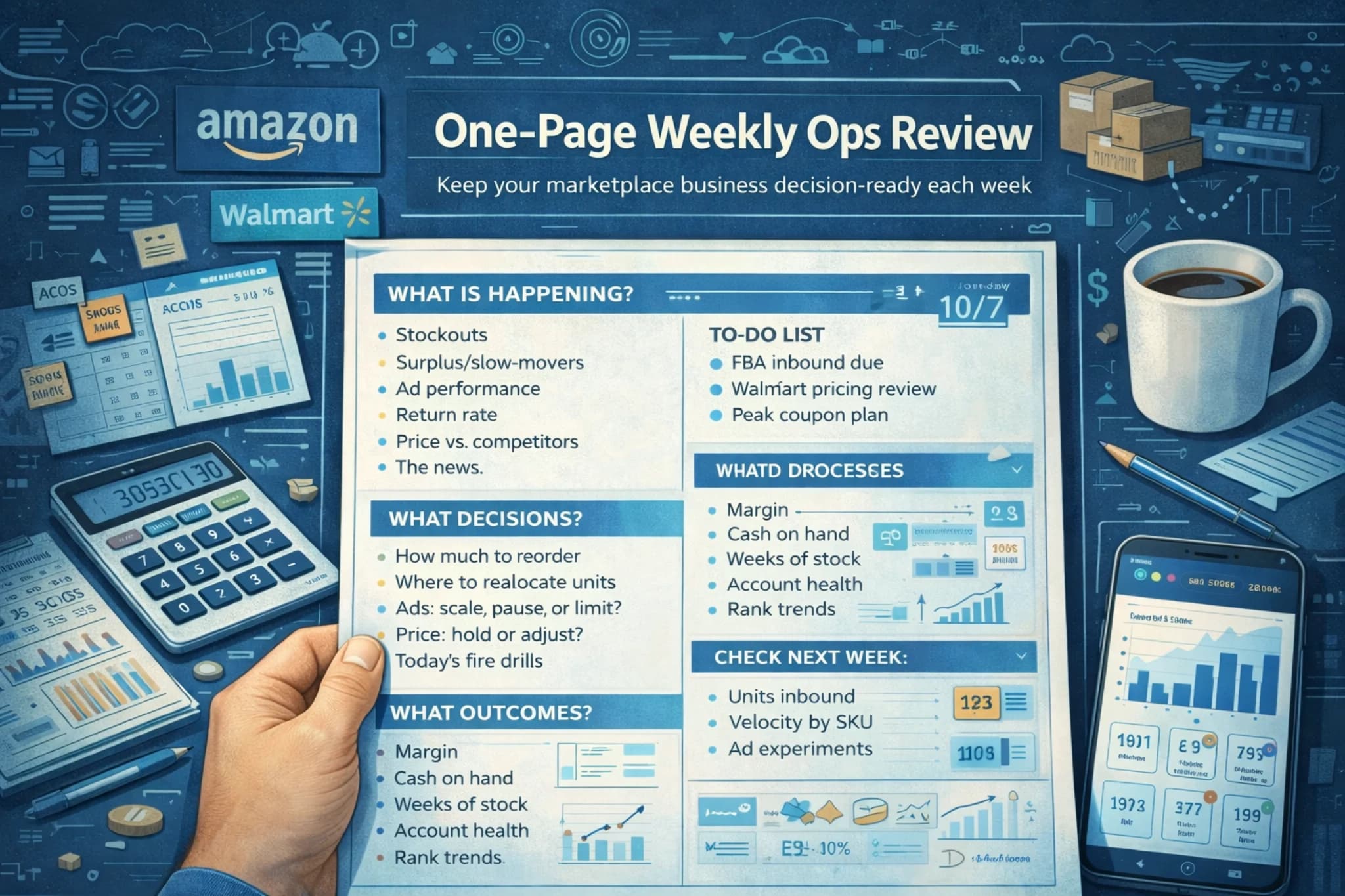
A simple rhythm for Amazon sellers (with Walmart/Shopify in mind) that turns data into repeatable decisions.
If you sell on Amazon, you’ve felt it: one small operational gap turns into a week of urgent decisions. You chase inventory counts, ad spend, pricing changes, and supplier timelines across a dozen tabs—then wonder why the same problems keep coming back.
Most marketplace sellers don’t need more data. They need a repeatable way to turn messy reality into clear weekly decisions—so outcomes improve and the business feels less reactive.
This post gives you a lightweight system you can run in 30 minutes a week: a one-page ops review that helps you spot risk early, make fewer “panic moves,” and learn from results.
Why a weekly ops review works (even if you’re solo)
Marketplace operations move fast, but the big mistakes happen slowly: a SKU drifts toward a stockout, returns creep up, ads spend more to get the same sales, and cash gets tied up in inventory you won’t move for 90 days.
A weekly review creates a forcing function: you decide before you’re forced. It also keeps your “why” in one place—so when something goes wrong, you can trace it back.
The one-page template (what to include)
Your one-page review should fit on a single screen or printed page. No perfection—just consistency. Here are the five sections that matter most for sellers:
Inventory health: weeks of cover, inbound status, and your next restock decision.
Demand & ads pacing: are you buying demand faster than you can fulfill—and at what margin?
Profit leaks: returns, storage fees, refunds, PPC waste, and any sudden cost spikes.
Listing & account health: suppressed listings, pricing errors, buy box volatility, and policy issues.
This week’s decisions: the 2–5 decisions you’re making now, with a short evidence note and a success metric.
How to run it in 30 minutes
Keep the cadence simple:
- Prep (10 minutes): pull the numbers you already check—inventory, sales velocity, ad spend, returns, inbound status.
- Review (15 minutes): scan for drift and decide what needs action this week.
- Log (5 minutes): write down the decision, why you made it, and what outcome you expect.
That last step is the cheat code. Most sellers act—but don’t capture the reason. Then you can’t learn from outcomes.
Decision guardrails (so you don’t create chaos)
Before you touch ads, pricing, or reorders, set a few guardrails. These reduce emotional decisions:
Margin floor: the lowest margin you’ll accept during a promo window.
Inventory buffer: the minimum weeks-of-cover you protect for hero SKUs.
Cash constraint: the maximum cash you’ll tie up in new POs this week.
Restock rule: the latest reorder date that still arrives before the next demand spike.
Stop conditions: what signals trigger a pause (e.g., returns spike, conversion drop, inbound delay).
A simple “weeks of cover” rule (Amazon-first)
You don’t need a perfect forecast to make better restock calls. Start with a simple weeks-of-cover view:
Weeks of cover = (available units + inbound units you trust) ÷ weekly sales velocity.
Then use a decision rule that fits your business:
If weeks of cover drops below 4 for a hero SKU, decide: reorder now or throttle demand (ads/price) to protect rank and margin.
If weeks of cover is 4–8, hold steady: avoid overreacting unless evidence changes.
If weeks of cover is above 10, watch storage/aging risk: decide whether to discount, bundle, or reduce reorders.
This isn’t “the truth.” It’s a stable decision baseline—so you can stop guessing and start improving.
Use the same page for Walmart and Shopify (without going multi-chaos)
If you’re expanding beyond Amazon, keep the same one-page format. The difference is only in constraints:
Shopify: focus on cashflow timing, repeat customers, and shipping SLAs (don’t starve your DTC channel if it funds inventory).
Walmart: watch price competitiveness and fulfillment performance—don’t push volume if operations can’t keep up.
Allocation: write down your weekly channel allocation decision for shared inventory so you don’t double-count units.
A quick example (what the “decision log” looks like)
A decision log line can be simple:
Decision: Increase ad budget +15% on SKU A for 5 days.
Evidence: Conversion stable, inventory cover 7.5 weeks, margin above floor, inbound confirmed.
Constraint: Pause if cover drops below 5 weeks or returns rise above X%.
Outcome: Maintain TACOS under Y% while increasing weekly profit by Z.
The point: fewer regrets, more learning
If you run this for four weeks, you’ll feel the difference. Not because you’ll predict everything—but because you’ll make decisions with evidence, constraints, and outcomes.
That’s how a small seller grows without becoming permanently reactive.